Journey to the Centre of the Rotor Blade
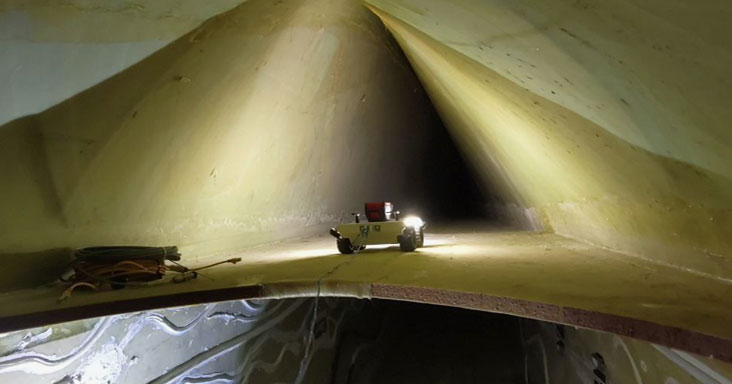
Rotor blades are very large components subject to extreme loads. It is therefore no surprise that they require regular inspection. Many people outside the industry primarily think of inspecting the outer shells of the blades—carried out by technicians on ropes or via drones. However, inspecting the interior of the blade is just as important as examining the exterior.
Because rotor blades are constructed from relatively thin shells, they contain large internal cavities. Inspectors can enter these spaces to check for cracks or other forms of damage. A key advantage—compared to external inspections—is the absence of a topcoat on the interior surfaces. This allows for a view into the blade shell itself, as the fiberglass and resin materials used possess a certain degree of transparency.
Nevertheless, only a small part of the blade’s total length is accessible to a person on foot. While it is possible to stand upright near the flange of modern blades, one must increasingly stoop when moving toward the tip. Eventually, it becomes necessary to crawl, yet even then, one can only reach about the midpoint of the blade. Consequently, roughly half of the blade’s interior cannot be inspected by a human.
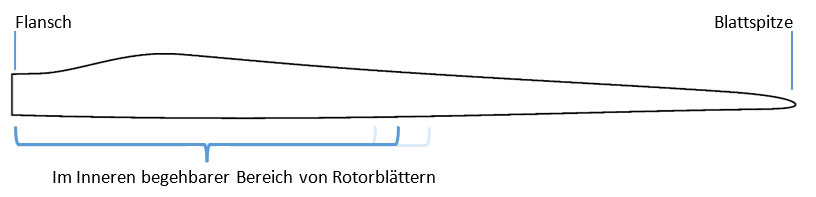
Rotor blades become increasingly slender toward the tip, meaning that a person can only inspect them from the inside up to about the halfway point.
Wait a minute! The space is too small for a human. But haven’t rotor blades been inspected from the outside using drones for years?! Surely, it should be easy enough to send a small robot inside a rotor blade! Surprisingly, this technology is not yet widely used in the inspection industry. Only a few companies offer such equipment, and often at a very high price point. Consequently, internal inspections today almost always stop halfway along the length of the blade.
For clever talents this serves as an incentive to develop a solution of their own. Given the vast array of motors, sensors, cameras, and electronic components available today—all at a reasonable cost—the technical potential is certainly there. However, the mere availability of individual parts does not automatically result in a functional inspection robot; it still requires the necessary know-how to design and build a reliable, integrated system.
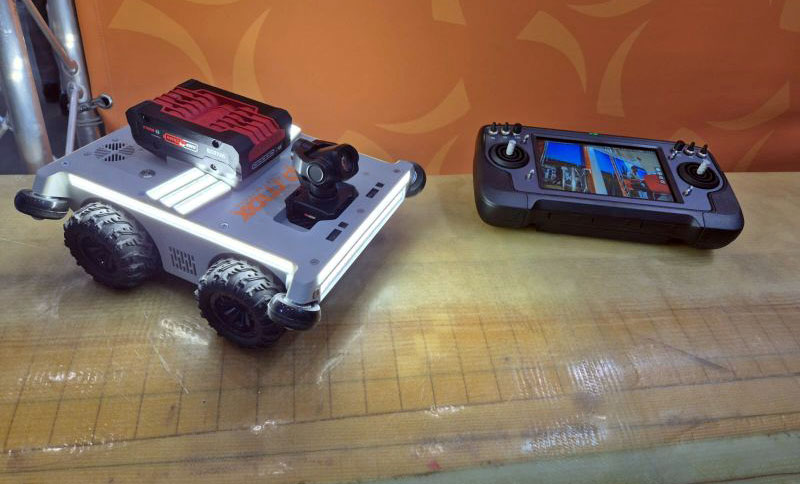
We are thrilled that Finn Thomas brought this expertise to our team. As part of his final project for his technical qualification, he built a functional, highly compact inspection robot on a modest budget. It can be remotely operated to reach the very tip of a blade, allowing for a detailed examination of the blade’s internal structure. To achieve this, it is equipped with several high-resolution cameras.
Since September, this rover has been used by cp.max as a supplementary tool for internal blade inspections.