
RobWIND
Collaborative research project:
Robot-based material recovery for wind turbine rotor blades
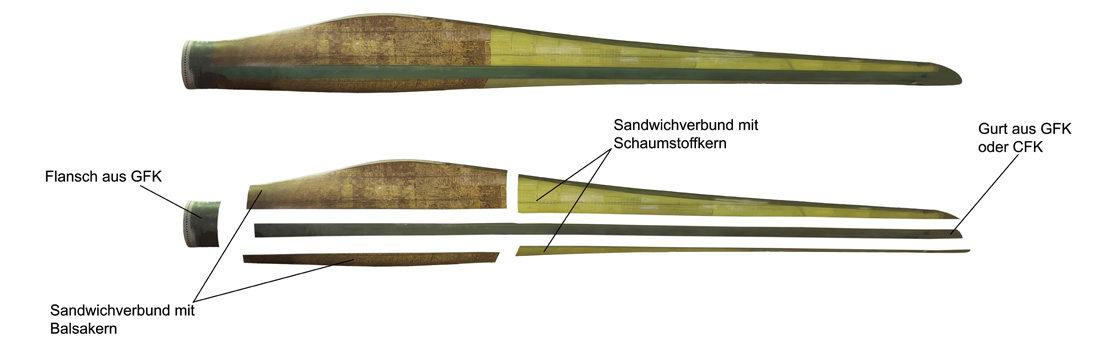
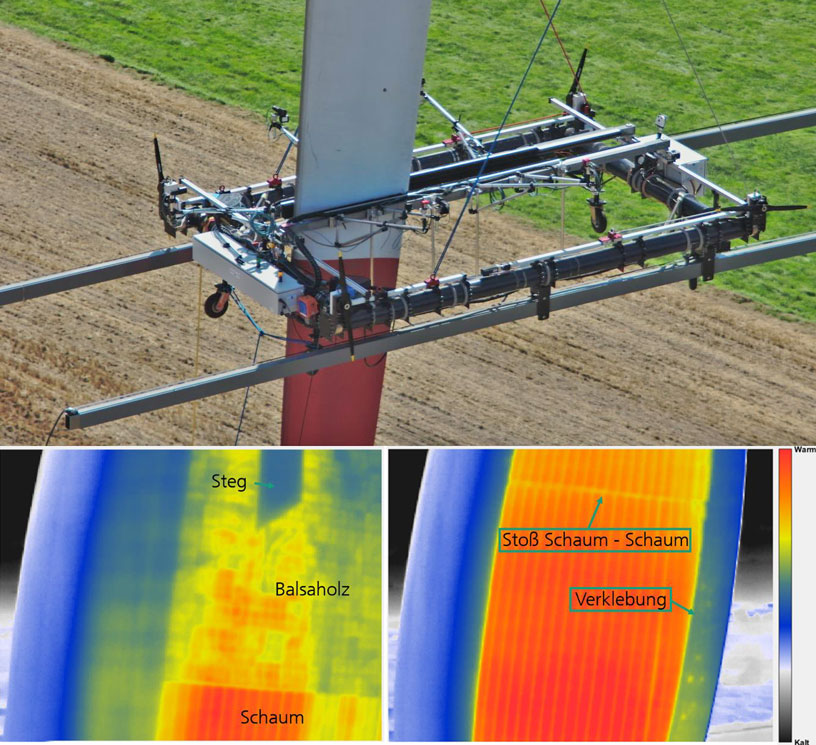
To enable targeted recycling of the various materials within a rotor blade, it is essential to know their exact location within the blade shells (Figure 1). A semi-automated inspection platform is designed to handle this task. It uses thermographic cameras to visualize the interior of the blade shells and generates a digital map of the materials used in the blade (Figure 2).
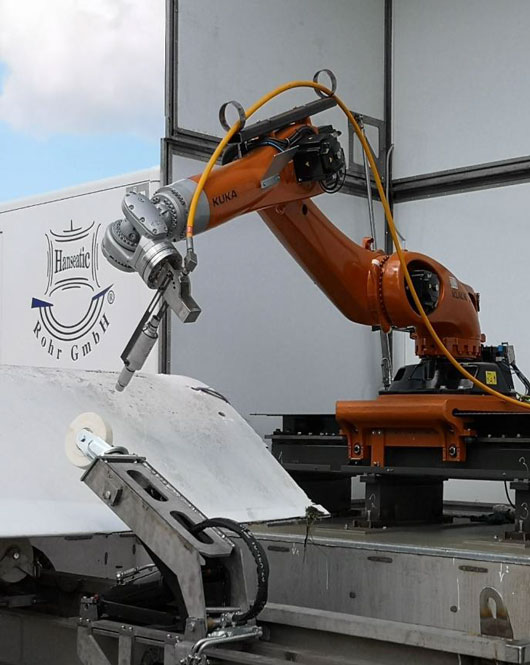
With this information, a standardized industrial robot equipped with a water-jet cutter can then automatically separate sections containing different blade materials (Figure 3). Since the robot is mobile, this dismantling process can take place right at the base of the wind turbine. This also significantly simplifies blade transport, as the blade is reduced to segments measuring only a few meters in length. In contrast, a modern rotor blade often exceeds 70 meters in length, making transport a complex and costly undertaking.
Background
Wind energy is one of the most sustainable forms of energy generation available. Significant resources and energy are consumed only during the manufacturing and installation of the turbines. Furthermore, the metal and concrete components can be effectively recycled during decommissioning.
However, recycling methods for rotor blades are not yet sufficiently developed. This is because a wide variety of materials within the blade are embedded in a plastic matrix. This plastic—a thermoset—cannot be melted down to easily separate the constituent materials. Consequently, rotor blades have traditionally been shredded without regard for their internal materials and subsequently processed via thermal recovery. However, given the projected sharp increase in the volume of decommissioned rotor blades in the medium to long term, this disposal method is not sustainable. Moreover, certain blade components must be removed prior to shredding. For instance, modern rotor blades often contain specific sections made of carbon fiber. These cannot be processed using conventional methods. They also represent a valuable material, making separate recovery financially advantageous.
The Challenge
Rotor blade shells do not have a homogeneous structure (see image above). Very different materials—such as glass fibers, carbon fibers, foam, and balsa wood—predominate in various large-area sections. If the rotor blade is unpainted, these areas are clearly visible. However, the blades are painted before being installed on the wind turbine. As a result, the boundaries between the materials are no longer visible.
Project duration: 01.11.2025 bis 31.10.2027
Dipl.-Ing. Thomas Heinecke
Forschung und Entwicklung
| Telefon: | 0351 85 89 345 0 |
| E-Mail: | t.heinecke@cpmax.com |
Projektpartner




Das Bundesministerium für Forschung, Technologie und Raumfahrt (BMFTR) fördert das Verbundprojekt „RobWIND“ zur Fördermaßnahme „Digital GreenTech - Umwelttechnik trifft Robotik“ im Rahmen der BMFTR-Strategie „Forschung für Nachhaltigkeit (FONA).