
Research history
Continuous monitoring of carbon-fiber-reinforced composites using acoustic emission analysis: QuantCarbon
Established testing methods for carbon-fiber-reinforced plastics—such as pulse-echo ultrasound or X-ray inspection—suffer from a major drawback: they are sensitive to structural damage only in the immediate vicinity of the sensor and are difficult to apply to complex, thick-walled geometries.
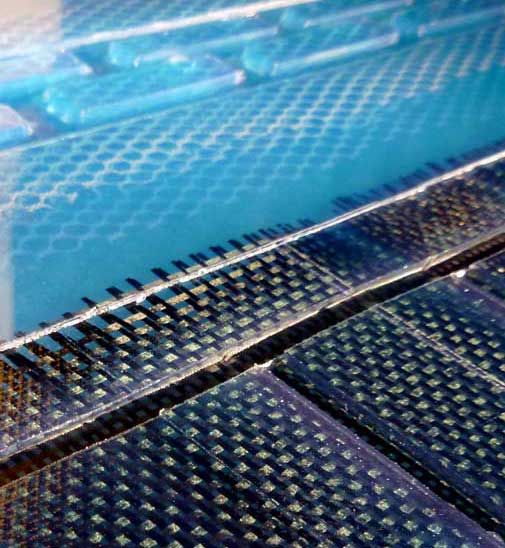
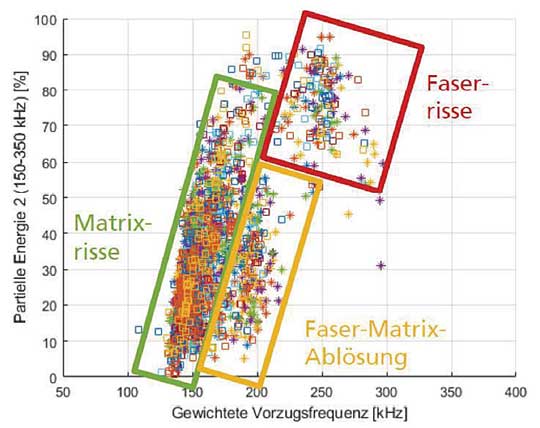
This research project therefore focuses on further developing an alternative technology. Acoustic emission analysis utilizes guided acoustic waves that propagate across a large area of the component following the occurrence of structural damage; these waves are then detected and localized by a limited number of sensors attached to the component. This allows acoustic sensors to monitor larger components, even when spaced widely apart. Acoustic emission analysis is already the state of the art for monitoring metallic structures.
The project aims to advance beyond the current state of the art—which is limited to localizing and characterizing individual acoustic events within a component—to a stage where assessments regarding the component's overall integrity can be made. To this end, tests are being conducted on both new components and components that have undergone repair. In the future, this method could also be used to continuously monitor rotor blades for damage.
Project partners:
- Fraunhofer-Institut für Keramische Technologien und Systeme IKTS
- IMA Materialforschung und Anwendungstechnik GmbH
- Leichtbau Zentrum Sachsen GmbH
- cp.max Rotortechnik GmbH & Co. KG

New low-temperature repair method: Cool Repair
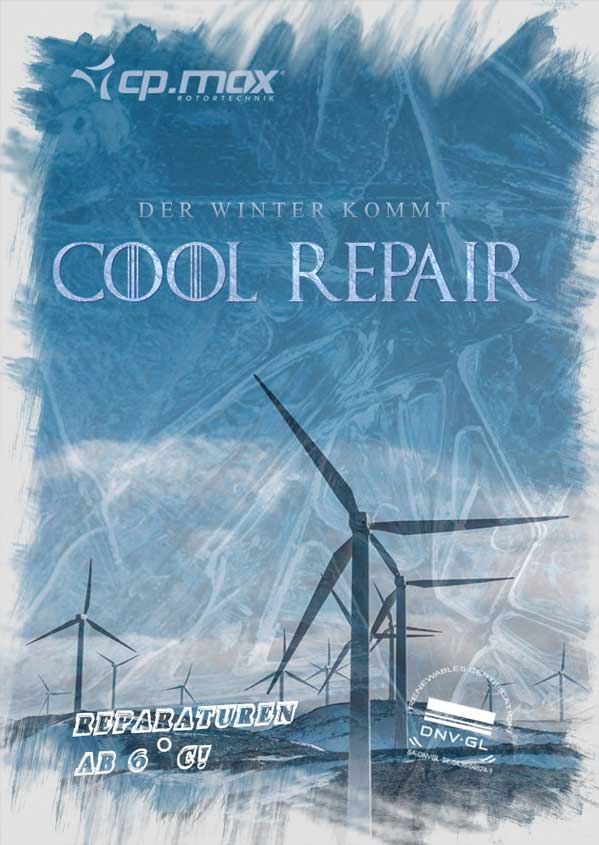
The resin systems used to manufacture rotor blades generally preclude repairs during periods of low ambient temperatures. Consequently, DNV GL mandates a relatively high minimum processing temperature of 16°C (DNVGL-ST-0376: Rotor blades for wind turbines). As a result, many rotor blades cannot be repaired for several months of the year.
With "Cool Repair," cp.max has significantly extended this repair window. The process enables work to be carried out at ambient temperatures as low as 6°C. This capability has been confirmed and certified by DNV GL, in addition to undergoing extensive internal testing. cp.max can thus further increase the availability of your wind turbines, as repairs can be performed promptly even under challenging conditions.
At the heart of the Cool Repair process is a heating and vacuum shroud that is placed directly over the repair site. An intelligent control system supplies the precise amount of thermal energy required to the laminate while simultaneously compressing the repair materials. In addition, the temperature profile is digitally recorded.
Cool Repair was developed jointly with the South German Plastics Center as part of the Central Innovation Programme for SMEs.