Increasing yield is not a dangerous adventure

Do you ever feel like Indiana Jones? Are you on a desperate hunt for lost treasure? But you don't chase it around the world, in the jungle or in hidden temples. No, you are chasing your treasure in the wind farm of Kleingümpersdorf.* You are on the trail for a part of the forecast yield that has mysteriously disappeared.
We are no tombraiders or adventurers with hats and whips. But we can help you with a very pragmatic and scientific approach to optimize the rotors of your wind turbines and win back the lost yield. These comparatively simple measures are presented below:
Balancing of the rotor
Millions of car wheels roll on the streets every day. They are all balanced. Surprisingly, this is not a standard with the much larger and heavier wind turbine rotors. According to statistics from the BWE, the majority of all wind turbines have an impermissibly high imbalance [1].
An imbalance on a very large rotor naturally also leads to major problems. After just a few years, the increased load can lead to costly defects in pitch systems, bearings, the machine frame and other drive train components.
A certain type of imbalance (the aerodynamic imbalance) can also result in a several percent yield loss. We therefore recommend balancing each wind turbine when it is commissioned. Unequally distributed masses and incorrectly set blade angles can be avoided right from the start. In addition, the balance condition should be checked after major repairs to the rotor blades. Incidentally, balancing the rotor involves comparatively little effort and expense. The consequences of a rotor imbalance, on the other hand, can quickly amount to a lost treasure.
Flow elements
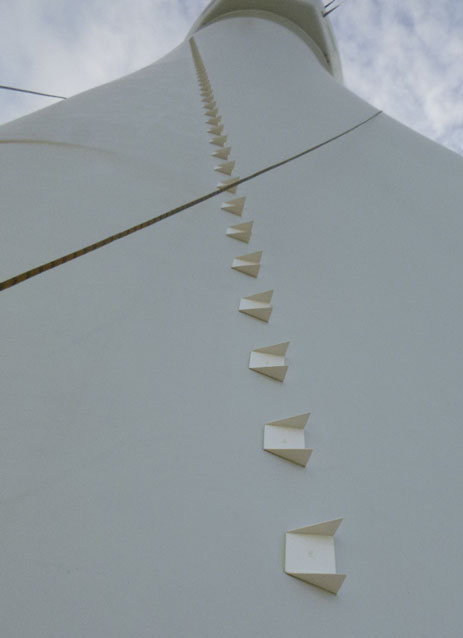
The shape of rotor blades is a compromise between optimal aerodynamics and a component that can be easily built, transported and installed on a wind turbine. Therefore, all rotor blades have a shape that is unfavorable for aerodynamics over about a third of their length (seen from the flange). Small add-on parts, so-called vortex generators (see Fig. 2), can significantly improve the aerodynamics in this area. Therefore, many manufacturers already equip modern rotor blades with vortex generators during production.
Incidentally, vortex generators prevent the air flow from detaching from the rotor blade. This detachment would lead to a loss of yield. Instead, the small, jagged components generate vortices of a defined size, so that the flow is again applied to the rotor blade. Therefore the flow elements must be the right size and installed in the right place.
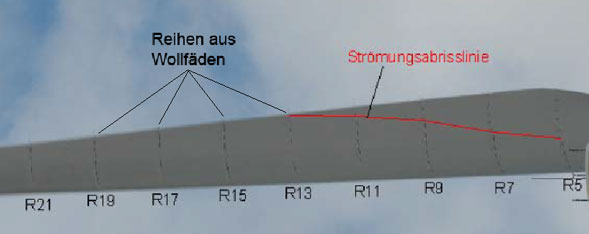
To check if installing vortex generators can improve yield and how to install the components, there is a simple but effective method. In the area of the flange, the suction side of the three rotor blades of a wind turbine is prepared with wool threads (see Figure 3). If the system is in operation, the orientation of the threads can be used to assess where the flow is optimally located on the blade surface. The wool threads then lie straight on the axis between the front and rear edges of the leaf. If the flow is separated, the wool threads flutter or they are strongly deflected towards the tip of the blade. The vortex generators are installed at this transition line between straight and deflected wool threads (see Figure 3).
With this amazingly simple procedure, the flow conditions for each location and each individual rotor blade can be viewed individually.
Yield increase through repairs
Many rotor blade repairs must be performed to avoid further amplifying the damage or because there is a direct safety risk. Less well known is that certain types of damage also reduce the yield, even though the stability of the rotor blade is not at risk.
Such damage is typically erosion on the leading edge of the rotor blades. Since the air flow is very sensitive to this rough surface, erosion can even cause yield losses of several percent [2]. Therefore, it is advisable to repair erosion early.
Incidentally, erosion is a major problem for rotor blades in general. How severe the erosion is, however, depends very much on the respective site conditions. In some places the problem is barely visible, while in unfavorable locations the blades are severely attacked. Erosion damage can also be repaired with manageable effort. Of course, the rotor blade remains installed on the system and the repair is carried out via rope access. It is also recommended to install a special anti-erosion film on the leading edge (outer third) at sites with severe erosion. This offers additional protection. However, the service life of this film also depends heavily on the location of use.
As you can see, the hunt for lost earnings is not hopeless. As described, there are several pragmatic starting points that can be checked easily for each system.
Needless to say, cp.max has many years of experience in implementing all these yield increasing measures...
Just contact us! We're here to help.
* All names have been changed for privacy reasons.
[2] https://windenergietage.de/2021/wp-content/uploads/sites/6/2021/11/29WT11_F17_1320_KWE_Erosion-am-Rotorblatt_Liersch.pdf